 Türkçe
  English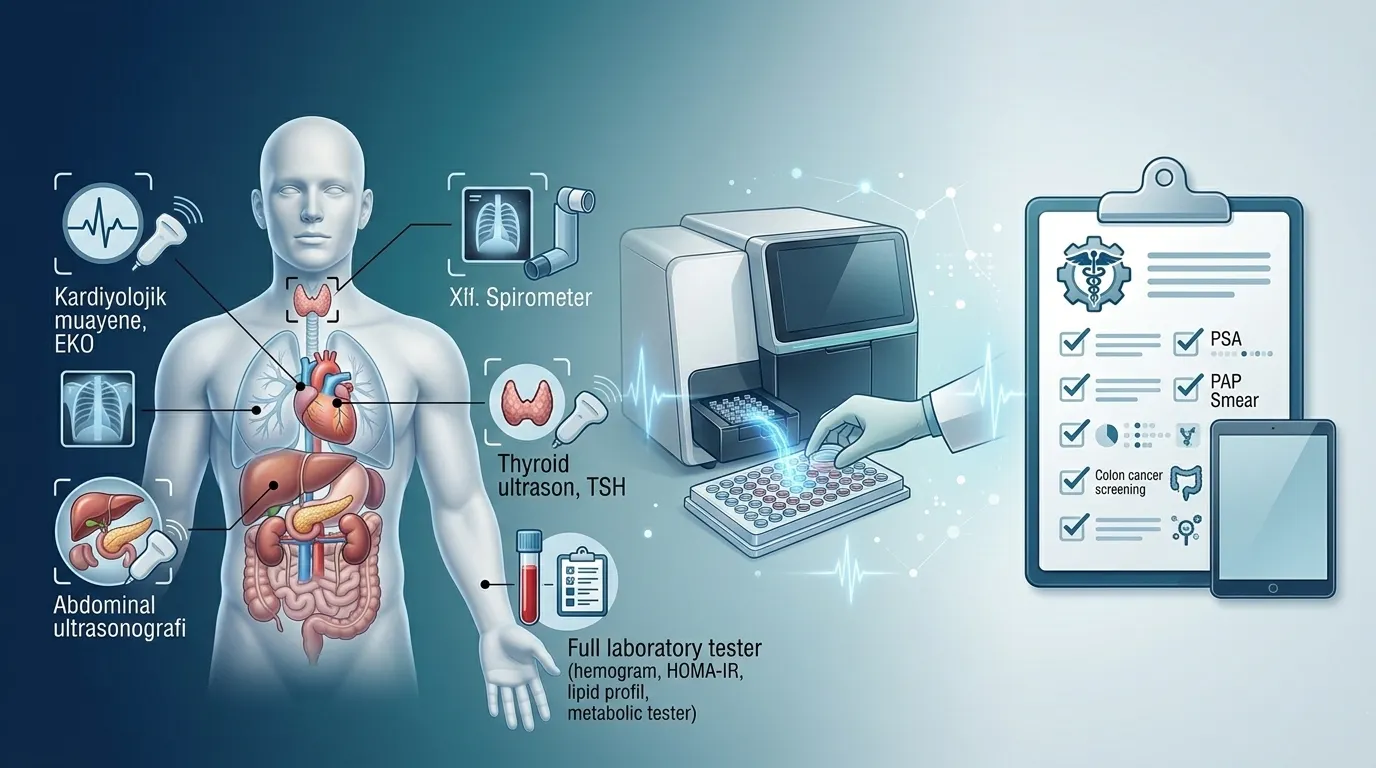
What Tests Should Be Included in a Comprehensive Check-Up Package?
- Specialist Doctor Examinations Performed Within the Scope of Check-Up
- Internal Medicine Examination
- Cardiology Examination
- Eye Diseases Examination
- Urology Examination (For Men)
- Gynecology Examination (For Women)
- Ear, Nose and Throat (ENT) Examination
- Laboratory Tests: Blood and Urine Tests
- Complete Blood Count (Hemogram)
- Metabolic Assessment: Blood Sugar and Insulin Resistance (HOMA-IR)
- Cholesterol and Lipid Profile (HDL, LDL, Triglyceride)
- Liver Function Tests (AST, ALT, GGT, ALP, Bilirubin)
- Kidney Function Tests (Urea, Creatinine, Uric Acid)
- Thyroid Function Tests (TSH, fT3, fT4)
- Vitamin and Mineral Levels (B12, Vitamin D, Folate, Iron)
- Complete Urine Analysis
- Cardiological Screening and Heart Health Tests
- Radiological Imaging and Advanced Examinations
- Chest X-ray (X-ray)
- Whole Abdomen (Intra-Abdominal) Ultrasonography
- Thyroid Ultrasound
- Breast Ultrasound and Mammography (For Women)
- Bone Density Measurement (Bone Densitometry)
- Cancer Screening Tests and Tumor Markers
- Prostate-Specific Antigen (PSA) Test
- Pap Smear and HPV Screening
- Fecal Occult Blood Test (Colon Cancer Screening)
- Tumor Markers (CEA, CA 125, CA 15-3, CA 19-9)
- Infection and Viral Marker Screenings
- Things to Consider Before Check-Up
In the modern medical world, “health” is not just the absence of symptoms, but the functioning of all the body’s systems in harmony.
Check-up is the most valuable investment made to create a biological map of your body and minimize potential risks before diseases knock on the door.
In this guide, we detail the essential elements that should be included in a full-fledged screening package according to academic standards.
Specialist Doctor Examinations Performed Within the Scope of Check-Up
The doctor’s examination is the most critical stage that translates the results of the technical tests into a meaningful clinical picture.
Laboratory results are just numbers; However, the physical examination combines these figures with the patient’s genetic heritage and lifestyle.
Internal Medicine Examination
The internist is the coordinator of the check-up process and evaluates all systemic findings in a general framework.
Body mass index, blood pressure measurement and functional status of general organ systems are examined at this stage.
Cardiology Examination
Since cardiovascular diseases are one of the most common health problems worldwide, cardiological evaluation is the heart of check-up.
Risks such as valve problems, rhythm disorders and arteriosclerosis are analyzed by the specialist physician.
Eye Diseases Examination
An eye exam doesn’t just measure visual acuity; It also helps us understand the impact of systemic diseases such as diabetes and hypertension on the vessels.
Urology Examination (For Men)
For male patients, it is a critical stage where prostate enlargement and cancer risk are evaluated and hormonal balance is observed.
Gynecology Examination (For Women)
Cervical cancer and breast health checks in women’s health screenings form the basis of preventive medicine.
Ear, Nose and Throat (ENT) Examination
Screening for pathologies in the hearing health, balance system, and upper respiratory tract directly affects overall quality of life.
Laboratory Tests: Blood and Urine Tests
Understanding the biochemical balance of the body allows us to see what is happening at the cellular level.
Complete Blood Count (Hemogram)
Anemia, the presence of a focus of infection and the capacity of immune system cells are measured with this test.
Metabolic Assessment: Blood Sugar and Insulin Resistance (HOMA-IR)
Fasting blood sugar alone is not enough to understand the risk of hidden sugar and diabetes; Insulin resistance values are the true mirror of metabolic health.
Cholesterol and Lipid Profile (HDL, LDL, Triglyceride)
Monitoring the balance of “good” and “bad” cholesterol for heart health is vital to prevent possible vascular occlusions.
Liver Function Tests (AST, ALT, GGT, ALP, Bilirubin)
Fatty liver, toxic effects or obstructions in the bile ducts are controlled by these parameters.
Kidney Function Tests (Urea, Creatinine, Uric Acid)
The filtering capacity and uric acid levels of the kidneys, which are the filtration center of the body, are monitored.
Thyroid Function Tests (TSH, fT3, fT4)
Overwork or underactivity of the thyroid gland, which manages the metabolic rate; It affects everything from weight balance to psychological state.
Vitamin and Mineral Levels (B12, Vitamin D, Folate, Iron)
Identifying deficiencies that are common in modern city life is essential for immunity and energy management.
Complete Urine Analysis
It offers quick and clear information about kidney health, urinary tract infection, and crystal formations in the body.
Cardiological Screening and Heart Health Tests
The heart is one of the organs most prone to silent diseases.
Electrocardiography (ECG)
It is a basic test that detects rhythm and conduction disorders by putting the electrical activity of the heart on paper.
Echocardiography (ECHO)
It is the process of imaging the heart with sound waves; The strength of the heart muscle and the anatomical structure of the valves are examined.
Effort Test (Treadmill)
By measuring the performance of the heart under physical stress, it reveals vascular stenosis that is not obvious at rest.
Radiological Imaging and Advanced Examinations
At points where physical examination is not enough, radiology makes the internal structure of the body transparent.
Chest X-ray (X-ray)
The condition of the lungs and the size of the heart shadow are screened to look for the presence of infection or mass.
Whole Abdomen (Intra-Abdominal) Ultrasonography
The anatomical structure of organs such as the liver, spleen, gallbladder, kidneys and pancreas is examined.
Thyroid Ultrasound
The presence of nodules in the thyroid gland and the risk of growth are monitored millimetrically by ultrasonography.
Breast Ultrasound and Mammography (For Women)
These tests, which are selected according to the structure of the breast tissue, are the “gold standard” for detecting breast cancer at an early stage.
Bone Density Measurement (Bone Densitometry)
The mineral content of bones is measured to determine the risk of osteoporosis (bone loss).
Cancer Screening Tests and Tumor Markers
Although tumor markers alone do not make a diagnosis, they are values that should be followed as a harbinger of a risk.
Prostate-Specific Antigen (PSA) Test
It is a specific blood test used in the monitoring of prostate diseases and cancer risk screening in men.
Pap Smear and HPV Screening
It is vital for early detection of cellular changes and the presence of viruses that can cause cervical cancer.
Fecal Occult Blood Test (Colon Cancer Screening)
It detects invisible bleeding in the digestive system and warns about intestinal health.
Tumor Markers (CEA, CA 125, CA 15-3, CA 19-9)
Blood levels of proteins released from specific organ systems are considered as a general screening parameter.
Infection and Viral Marker Screenings
Detecting viral diseases that spread silently is important for both individual and societal health.
Hepatitis Panel (HBsAg, Anti-HBs, Anti-HCV)
Immunity status and carrier status are screened against infectious hepatitis types that threaten liver health.
HIV Screening (Anti-HIV)
With the development of modern medicine, the presence of the HIV virus, which is life-saving in early diagnosis, is checked.
| Test Category | Main Purpose | Expected Benefit |
| Cardiological Tests | Examining the structure of the heart and vessels | Detecting the risk of heart attack in advance |
| Biochemical Tests | Measuring organ functions | Prevent diabetes, liver and kidney failure |
| Radiological Scan | Seeing the anatomy of internal organs | Diagnosing mass and structural disorders |
Things to Consider Before Check-Up
The accuracy of the tests is directly related to how well you comply with the preparation process.
Fasting Period and Medication Use
A fasting period of 8-12 hours is usually required for blood tests to give healthy results.
If you have medications that you use regularly, you should definitely consult your doctor whether you should stop them.
Appointment Preparation and Lifestyle Recommendations
Wearing comfortable clothing and avoiding heavy sports on the day of the appointment is recommended for the stability of the test results.
According to Dr. Ferit Arğun: “Do not think of your check-up results as an exam result; This is a current situation analysis. Even the most perfect tests will be incomplete unless combined with the clinical experience of a specialist doctor. Even if your test results are normal, maintaining healthy lifestyle habits and not skipping annual check-ups is the key to long-term health.”
If you do not want to leave your health to chance, you can consult a specialist to determine the most suitable check-up package for your age and genetic risks.