 Türkçe
  English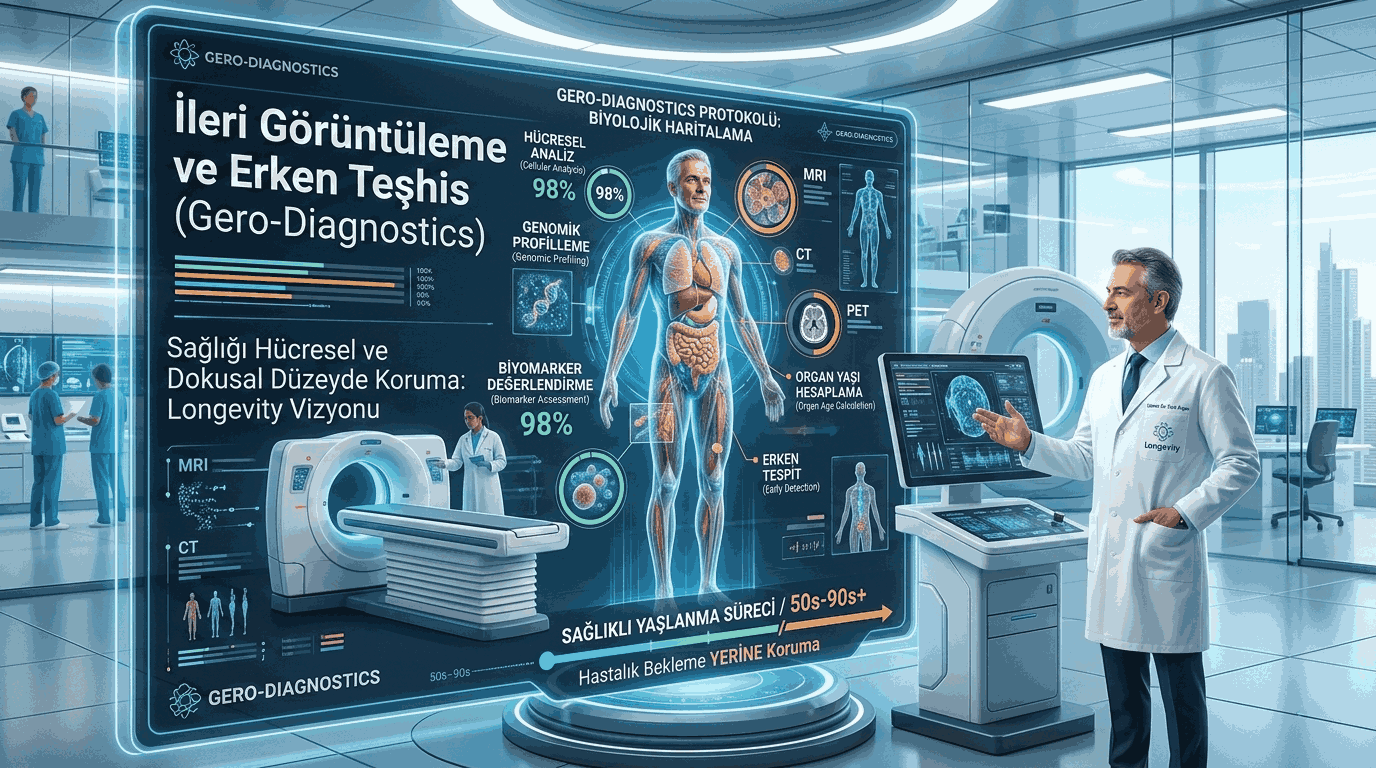
Advanced Imaging and Early Diagnosis (Gero-Diagnostics)
Instead of waiting for diseases to occur, modern medical understanding has evolved into the phase of protecting health at the cellular and textural level.
Gero-Diagnostics protocols, shaped by Dr. Ferit Arğun’s vision of longevity, place the healthy aging process on a scientific basis by mapping the body’s biological map with the most advanced imaging technologies.
What is Gero-Diagnostics?
Gero-Diagnostics is a holistic diagnostic discipline that aims to detect the rate of aging and age-related chronic diseases (oncological, cardiovascular, neurodegenerative) at a stage when they do not yet show clinical symptoms.
While standard screening methods seek an answer to the question “Is there a disease?”; Gero-Diagnostics focuses on the question “what is the functional capacity of the body and how can future risks be minimized?”
This approach constitutes the most critical step of Longevity medicine and offers a personalized “early warning system”.
From symptom management to “pre-disease” detection
Classical medicine usually intervenes after symptoms appear. However, degenerative processes such as cancer, heart disease or Alzheimer’s begin at the molecular level, years before they give symptoms.
- Reactive Medicine: When symptoms develop, they diagnose and treat them.
- Proactive (Gero-Diagnostic) Medicine: It captures microchanges in tissues, early calcifications in the vessel wall and cellular stress signals in the “pre-disease” stage.
Interventions at this stage have the potential to stop the formation of the disease or radically slow down its process.
Advanced Imaging Technologies and Radiological Check-Up
Diagnostic accuracy is directly related to the sensitivity of the technology used and the quality of data processing. The radiological check-up protocols used in our clinic consist of a selection that aims for the highest tissue resolution with the lowest radiation exposure.
Whole Body MRI: Comprehensive Cancer Screening and Organ Health
Whole Body MRI is a radiation-free imaging method and offers the opportunity to scan all organ systems from head to toe in a single session.
- Cancer Screening: It can detect small tumor foci of a few millimeters, which classical methods may miss, at the initial stage.
- Texture Analysis: It offers a wide data set from fatty liver to pancreatic cysts, from lymph node changes to joint degeneration.
- Radiation-Free Safety: Thanks to its lack of ionizing radiation, it is the gold standard for periodic screening (annual follow-up) in healthy individuals.
Artificial Intelligence Supported Radiomic Analysis and Image Processing Techniques
The images obtained during the Gero-Diagnostics process are analyzed not only by the radiologist’s eye but also by artificial intelligence (AI)-based radiomic software.
- Quantitative Data: It translates tissue tissue changes that cannot be noticed with the naked eye into numerical data.
- Risk Estimation: AI algorithms compare existing image data with millions of cases to predict the likelihood of benign or malignant lesions with high accuracy.
This technology minimizes the share of “human error” and turns data into a “life strategy”.
Vascular Age Analysis: Detecting Cardiovascular Risks Years in Advance
Many cases, such as heart attack and stroke, occur in individuals with normal standard cholesterol tests. Vascular age analysis determines your biological vascular health by measuring the elasticity of the vessel wall and endothelial functions.
- Calcium Scoring: It detects the calcification load in the coronary vessels.
- Intima-Media Thickness: Maps the risk of future stroke by measuring the thickening of the carotid artery wall.
| Feature | Standard Check-Up | Gero-Diagnostic (İleri) Teşhis |
| Focus Point | Apparent disease detection | Pre-disease stage |
| Technology | Basic blood test, Ultrasound | Whole Body MRI, AI Analysis, Epigenetics |
| Radiation | Standard protocols | Minimum or zero radiation |
| Conclusion | “Normal” or “Abnormal” report | Personalized “Longevity” roadmap |
Liquid Biopsy and Biomarker Panels: Early Warning at the Cellular Level
Revolutionary advances in laboratory medicine now allow us to read cellular changes in the deepest corners of the body through a blood sample. The liquid biopsy and advanced biomarker panels included in our Gero-Diagnostics protocol go to a molecular depth that conventional check-up scans cannot reach.
Early Stage Cancer Screening Tests (ctDNA and Protein Markers)
While traditional screening methods wait for a mass to physically form, Liquid Biopsy technology scans for circulating tumor DNA (ctDNA) and specific protein signals in the blood.
- Molecular Precision: It has the potential to detect cellular deviations that are too small to be noticed on any imaging device (MRI or CT) yet.
- Multiple Cancer Screening: It simultaneously analyzes oncological risks in different organ systems of the body with a single blood sample.
The Epigenetic Clock and Biological Age Measurement: Diagnosing the Rate of Aging
Your chronological age (date of birth) does not tell you how fast your cells are aging. Epigenetic Clock tests performed at Dr. Ferit Arğun clinic calculate your real “biological age” by examining methylation patterns on DNA.
- Aging Rate Analysis: It scientifically reveals whether your body ages faster or slower than the calendar year.
- Intervention Tracking: It allows us to numerically track the healing effect of the applied Longevity protocols (nutrition, IV treatments, lifestyle) on your biological age.
Neuro-Vascular Screening: Pre-Clinical Analysis of Alzheimer’s and Dementia Risks
Neurodegenerative diseases usually show symptoms after a “silent phase” of 10-15 years. With the Gero-Diagnostics approach, we analyze specific proteins (Amyloid-beta, Tau, NfL) that indicate nervous system damage with blood or advanced imaging data. This ensures that protective measures are taken long before cognitive loss begins.
Functional Laboratory Analyses: Turning Biochemical Data into Insights
The “reference ranges” in standard laboratory results are broad ranges that usually cover 95% of the population. Our focus is not on “normal” values, but on “optimal” values.
Diagnosing Hormonal and Metabolic Balance: Insulin Resistance and Inflammation Monitoring
Instead of just looking at fasting blood sugar; we examine markers of systemic inflammation such as insulin sensitivity, HbA1c fluctuations, and high-sensitivity CRP (hs-CRP). These analyzes help us detect loss of metabolic flexibility, which is the earliest sign of diabetes and heart disease.
Microbiota Analysis: The Relationship of Gut Health with Systemic Diseases
The gut microbiota, called the “second brain”, governs everything from the immune system to mental health. With advanced microbiota tests, we measure the bacterial diversity and inflammation potential in the intestine and analyze the risks of systemic diseases from their source.
Dr. Ferit Arğun Nisantasi Clinic: Boutique Gero-Diagnostic Protocols
At our Nisantasi clinic, the diagnostic process does not end with the submission of a laboratory report; on the contrary, it starts with that report.
Personalized Early Warning System and Risk Mapping
Each individual’s genetic heritage and lifestyle are different. We synthesize the advanced imaging and biochemical data we obtain with Dr. Ferit Arğun’s clinical experience and create a special Risk Map for you. This map allows you to see your health projection for the next 10-20 years.
Integration of Advanced Diagnostic Data into Lifestyle and Treatment Plan
Diagnosis is the basis of the action plan. Even the smallest deviation detected; The personalized nutrition plan is optimized with targeted food supplements or cellular renewal (regenerative) treatments.
Frequently Asked Questions
How often should I have Gero-Diagnostics tests?
This varies based on the person’s current biological age and risk profile. Annual follow-ups with selected parameters are recommended, usually after a thorough baseline analysis.
Do these tests tell me if I have a genetic predisposition?
Yes, our genetic panels and epigenetic tests in particular analyze both your innate predispositions and the current activity (expression) of these genes.
How is it different from a regular check-up?
While the normal check-up tries to “catch an existing disease”; Gero-Diagnostics focuses on “stopping the process leading to disease while it is still in the cellular stage”.